Les JCB 2025 ont eu lieu du lundi 3 février 9h au mercredi 5 février 12h.
Les exposés ont eu lieu dans l’amphithéâtre du LaBRI (Bâtiment A30) à l’Université de Bordeaux.
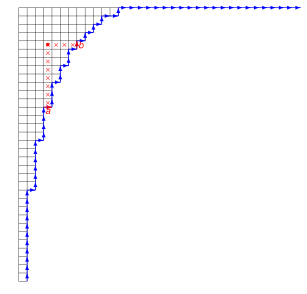
Figure : Maria Bras-Amorós

Orateurs
Accéder aux résumés au format pdf et aux supports de présentation.
- Maria Bras-Amorós
Numerical semigroups
Résumé
A numerical semigroup is a subset of the nonnegative integers,
, that is closed under addition and has a finite complement in . This complement of the numerical semigroup is called its gap set and the number of gaps is its genus. Numerical semigroups arise in algebraic geometry, coding theory, privacy models, and in musical analysis. It has been shown that the sequence counting the number of semigroups of each given genus g, denoted
, for , has a Fibonacci-like asymptotic behavior. It is still not proved that, for each g, or, even more simple, . We will explain some classical problems on numerical semigroups and we will explain the approach of counting semigroups by means of trees.
- Pierre Bonnet
Classification des marches à bords interactifs de genre 0
Résumé
L’étude systématique des marches dans le quart de plan a fait l’objet de nombreux efforts les dix dernières années, concernant notamment la classification des marches à petits pas, qui a été achevée en 2018. Depuis, de multiples extensions ont été considérées : ajout de poids, pas de longueur arbitraire… L’extension considérée ici concerne la statistique du nombre de contacts avec les axes du quart de plan pour les marches à petits pas, démarrée par Beaton et Owczarek en 2020. Dans cet exposé, je présente la classification de ces marches dites “de genre 0”, qui utilise de manière cruciale la méthode de Dreyfus, Hardouin, Roques et Singer basée sur l’étude des équations aux-différences. Contrairement aux marches sans interactions, cette étude révèle des solutions algébriques. - Alicia Castro
Irreducible Metric Maps from a Substitution Approach
Résumé
In this talk, I will introduce irreducible metric maps and show how they are related to metric maps without an irreducibility constraint. This connection is established by identifying the appropriate disk function substitution, drawing an analogy with the discrete map case. With this substitution, we compute their moments and generating functions. Notably, we rediscover a relationship between the enumeration of irreducible metric maps and hyperbolic surfaces. This talk is based on work to be published in collaboration with Timothy Budd. - Jean-René Chazottes
Formalisme thermodynamique, dynamique symbolique et modèles de quasi-cristaux
Résumé
L’étude de modèles simples de physique statistique sur le réseau
, visant à comprendre la transition d’un état désordonné vers un ordre périodique ou quasi-périodique à basse température, révèle un lien naturel entre le formalisme des mesures de Gibbs et des états d’équilibre, la dynamique symbolique multidimensionnelle, les pavages apériodiques, et l’informatique théorique. Cet exposé propose un panorama introductif de ce domaine de recherche. Version anglaise : Thermodynamic Formalism, Symbolic Dynamics, and Quasicrystal Models
The study of simple statistical physics models on the lattice
, aimed at understanding the transition from a disordered state to a periodic or quasi-periodic order at low temperatures, reveals a natural connection between the formalism of Gibbs measures and equilibrium states, multidimensional symbolic dynamics, aperiodic tilings, and theoretical computer science. This talk offers an introductory overview of this research area. - Alice Contat
Parking sur des arbres de Bienaymé—Galton—Watson géométriques surcritiques
Résumé
Considérons un arbre enraciné dont les sommets seront interprétés comme des places de parking, chaque place pouvant accueillir au maximum une voiture. Sur chaque sommet de l’arbre, on ajoute une étiquette entière et positive représentant le nombre de voitures arrivant sur ce sommet. Chaque voiture essaie de se garer sur son sommet d’arrivée et, si la place est occupée, elle descend en direction de la racine de l’arbre jusqu’à ce qu’elle trouve un sommet vide où se garer. S’il n’y a pas de sommet libre sur le chemin vers la racine, la voiture sort de l’arbre, contribuant ainsi au flux de voitures à la racine. Ce modèle présent une transition de phase intéressante que nous allons analyser en détail. Après un aperçu du cas où l’arbre sous-jacent est un arbre critique de Bienaymé-Galton-Watson, nous nous concentrerons sur le cas des arbres surcritiques avec loi géométrique, où la transition de phase qui s’avère être “discontinue”. L’exposé est principalement basé sur un travail joint avec Linxiao Chen. - Victor Dubach
Binary search trees of permuton samples
Résumé
Binary search trees (BST) are a popular type of structure when dealing with ordered data. They allow efficient access and modification of the data, as long as their height is not too large. When the data arrive in a uniformly random order, a famous result by Devroye (1986) states that their height is logarithmic, making BSTs very efficient. However, except in a few cases, much less is known when the input is a non-uniform permutation.
The model we will consider in this talk (“permuton samples”) is a broad and emerging family of non-uniform random permutations, whose construction relies on i.i.d. random points in the plane. After defining and motivating this model we will show that, under mild assumptions on the sampling distribution
, the height of these BSTs is still logarithmic. Furthermore, the asymptotic proportion of nodes in any given subtree (“subtree size convergence”) is explicit and depends only on the behavior of near its boundary. - Thomas Gerber
Coeurs et équations diophantiennes
Résumé
L’étude des coeurs, c’est-à-dire les partitions d’entiers sans crochet de taille donnée, a révélé des relations remarquables entre la théorie des représentations, la combinatoire énumérative, et la théorie des nombres. Dans cet exposé, j’expliquerai comment relier les partitions coeurs aux solutions de certaines équations diophantiennes, sur lesquelles agira un groupe adapté.
Version anglaise : Cores and Diophantine equations
The study of cores, those integer partitions with no hooks of a given size, has revealed over the years remarkable connections between representation theory, enumerative combinatorics, and number theory. In this talk, I will present a link between core partitions and certain Diophantine equations, whose solution set will be endowed with an appropriate group action.
- Herman Goulet-Ouellet
Facteurs bispéciaux dans les systèmes D0L et comment les calculer
Résumé
Un système D0L est un modèle simple où une règle de production (morphisme) est itérée sur un certain mot fini (axiome) afin d’obtenir un langage et, dans plusieurs cas, un mot infini. Certains exemples connus, comme les mots de Thue–Morse et de Fibonacci, s’obtiennent de cette façon. Dans mon exposé, je vais parler plus précisément de la notion de facteur bispécial dans le contexte des systèmes D0L. Les facteurs bispéciaux jouent un rôle clé en théorie des langages, où ils sont liés par exemple à la complexité en facteurs ou encore aux mots de retour. En 2012, Karel Klouda a démontré que, sous certaines conditions, les facteurs bispéciaux du langage défini par un système D0L peuvent être décrits grâce à une structure de données finie. Encore mieux, sa preuve montre aussi que cette structure peut être calculée algorithmiquement. Après une brève introduction générale aux systèmes D0L, je vais présenter nos efforts récents, en collaboration avec Štěpán Starosta et Karel Klouda, visant à généraliser, optimiser, et implémenter (dans SageMath) l’algorithme décrit par Karel. - Alice Pellet-Mary
Cryptography and isomorphism of lattices and graphs
Résumé
In the first part of the talk, we will see how to encrypt messages, by relying on the hardness of the lattice isomorphism problem. This problem asks, given two isomorphic lattices (i.e., lattices that are the same up to an orthonormal transformation), to recover an isomorphism sending one lattice to the other one. In a second part, we will describe an (inefficient) algorithm that finds isomorphisms between lattices and see its connection with graph isomorphism. - Martin Rubey
Two equidistributed parameters on unlabelled graphs
Résumé
A pair of parameters, that is, integer valued functions on a set of objects, is equidistributed, if their generating functions coincide.
We present a pair of equidistributed parameters on the set of simple unlabelled graphs on n vertices.
The number of parameters on graphs that have been studied is quite remarkable: findstat.org currently lists roughly 300 such statistics, from the arboricity number to the Zagreb index, and there are other websites and also a book whose only aim is to collect graph parameters.
However, in stark contrast to other collections of objects, such as integer partitions, permutations or Dyck paths, no pair of equidistributed parameters has been found so far.
As of now, we do not know of a bijection that would prove our result, which is why we follow Ira Gessel and Ji Li and use the theory of combinatorial species and functional equations instead.
This is joint work with Florian Fürnsinn and Moritz Gangl.
- Andrea Sportiello
Around the Razumov–Stroganov correspondence: old and new
Résumé
There exists a nice mechanism relating Integrable systems à la Baxter and the Algebraic Combinatorics of symmetric polynomials. But the Razumov-Stroganov conjecture (RS) of Integrable systems, relating Fully-Packed Loop configurations (FPL) to the steady state of the O(1) Dense Loop Model (DLM) on a semi-infinite cylinder, is out of the framework above, and somehow mysterious. One version of RS (with dihedral symmetry) has been finally proven years ago, by Cantini and myself, but the other versions (with boundaries) are open up to date.
Efforts for proving RS have led to several other interesting facts, and many new, even more mysterious, conjectures: certain “FPL in a triangle” see the appearence of Littlewood-Richardson coefficients (Nadeau), and a conjectural 3-index relation (P. Zinn-Justin), which, projected to 2 indices alone, would imply RS; Littlewood-Richardson coefficients for the canonical Grothendieck polynomials seem to appear in VSASM’s (Cantini-S.); there exists a version of (dihedral) RS that involves both colours of the FPL’s, and the DLM on finite cylinders (Cantini-S.).
We will try to go through all these interesting directions, and motivate the audience towards this fascinating field.
- Zoé Varin
Modèles stochastiques de dispersion sur le cercle
Résumé
Imaginons des gouttes d’eau qui tombent successivement et aléatoirement, sur le cercle unité
. La goutte d’eau numéro a masse et arrive en position , uniforme sur . On suppose qu’une goutte de masse a la capacité d’humidifier une partie de de mesure de Lebesgue . Qu’elle tombe sur une partie déjà humide, ou sèche, elle va étendre le domaine humide continûment, jusqu’au moment où la tache humide a gagné une mesure de Lebesgue . La manière dont la tâche humide s’agrandit lors de l’arrivée d’une goutte est l’un des paramètres du modèle, et on peut imaginer qu’il s’agit d’un phénomène aléatoire, ou pas, peu importe… car sous des hypothèses raisonnables (d’invariance par rotation du modèle, et de localité de la politique de dispersion des masses), on montre une propriété d’échangeabilité, qui implique que la loi des blocs occupés (humides) et libres (secs), et donc leur nombre, est indépendante de la politique de dispersion des masses.
Cette propriété permet de calculer explicitement la loi du nombre de blocs libres et de leur taille : cette loi ne dépend pas des masses individuelles, mais uniquement de leur somme et de leur nombre. La loi des tailles des blocs occupés, quant à elle, dépend de la distribution des masses, mais peut aussi être calculée.
On peut également établir le même genre de résultats sur des modèles où les masses arrivent sur
. Un cas particulier de ce modèle est le modèle de parking, étudié notamment par Chassaing-Louchard. Nous montrons enfin que certaines additives fonctionnelles de ces modèles (correspondant à la somme des coûts de déposition des masses, par exemple) convergent en loi, sous des hypothèses raisonnables sur les masses
. Cela permet de retrouver le coût du parking dans le cas classique, mais également d’analyser le coût d’autres politiques de déplacement. Travail en commun avec Jean-François Marckert.
Emploi du temps
Lundi 3 février
| horaire | orateur | titre |
|---|---|---|
| 09h00-10h00 | Jean-René Chazottes | Formalisme thermodynamique, dynamique symbolique et modèles de quasi-cristaux |
| 10h30-11h30 | Pierre Bonnet | Classification des marches à bords interactifs de genre 0 |
| 11h30-12h30 | Alice Contat | Parking sur des arbres de Bienaymé—Galton—Watson géométriques surcritiques |
| 12h45-13h45 | repas | |
| 15h00-16h00 | Alice Pellet-Mary | Cryptography and isomorphism of lattices and graphs |
| 16h30-17h30 | Herman Goulet-Ouellet | Facteurs bispéciaux dans les systèmes D0L et comment les calculer |
Mardi 4 février
| horaire | orateur | titre |
|---|---|---|
| 09h00-10h00 | Maria Bras-Amorós | Numerical semigroups |
| 10h30-11h30 | Victor Dubach | Binary search trees of permuton samples |
| 11h30-12h30 | Thomas Gerber | Coeurs et équations diophantiennes |
| 12h45-13h45 | repas | |
| 15h00-16h00 | Andrea Sportiello | Around the Razumov–Stroganov correspondence: old and new |
| 16h30-17h30 | Alicia Castro | Irreducible Metric Maps from a Substitution Approach |
Mercredi 5 février
| horaire | orateur | titre |
|---|---|---|
| 09h00-10h00 | Martin Rubey | Two equidistributed parameters on unlabelled graphs |
| 10h30-11h30 | Zoé Varin | Modèles stochastiques de dispersion sur le cercle |
| 11h45-12h45 | repas |
Participants
- Jean-Christophe Aval (LaBRI, Université de Bordeaux)
- Eric Balandraud (IMB, Université de Bordeaux)
- Axel Bacher (LIPN, Université Sorbonne Paris Nord (Paris 13))
- Cyril Banderier (LIPN, Université Sorbonne Paris Nord (Paris 13))
- Frédérique Bassino (LIPN, Université Sorbonne Paris Nord (Paris 13))
- Nicolas Bonichon (LaBRI, Université de Bordeaux)
- Pierre Bonnet (LaBRI, Université de Bordeaux)
- Vladimir Boskovic (IPhT Paris-Saclay)
- Romain Bourneuf (LaBRI, Université de Bordeaux)
- Mireille Bousquet-Mélou (LaBRI, Université de Bordeaux)
- Maria Bras-Amorós (Universitat Rovira i Virgili)
- Pierrette Cassou-Nogues (IMB, Université de Bordeaux)
- Alicia Castro (LaBRI, Université de Bordeaux)
- Jean-René Chazottes (CPHT, CNRS, École polytechnique)
- Alice Contat (LAGA, Université Sorbonne Paris Nord (Paris 13))
- Julien Courtiel (GREYC, Université de Caen Normandie)
- Vincent Delecroix (LaBRI, Université de Bordeaux)
- Victor Dubach (IECL, Université de Lorraine)
- Philippe Duchon (LaBRI, Université de Bordeaux)
- Andrew Elvey Price (IDP, Université d’Orléans)
- Luis Fredes (IMB, Université de Bordeaux)
- Oscar Fontaine (LaBRI, Université de Bordeaux)
- Vincent Ghigo (LaBRI, Université de Bordeaux)
- Solal Gaudin (ICJ, Université Claude Bernard (Lyon 1))
- Thomas Gerber (ICJ, Université Claude Bernard (Lyon 1))
- Herman Goulet-Ouellet (Université Technique de Prague)
- Olivier Guibert (LaBRI, Université de Bordeaux)
- Frederic Jouhet (ICJ, Université Lyon 1)
- Florent Koechlin (LIPN, Université Sorbonne Paris Nord (Paris 13))
- Léo Kulinski (LISN, Université Paris-Saclay)
- Bastien Laboureix (Centre Borelli, ENS Paris-Saclay)
- Arthur Leonard (IMB, Université de Bordeaux)
- Sébastien Labbé (LaBRI, Université de Bordeaux)
- Mohamed Lamine Lamali (LaBRI, Université de Bordeaux)
- Yvan Le Borgne (LaBRI, Université de Bordeaux)
- Loïc Le Mogne (LISN, Université Paris-Saclay)
- Baptiste Louf (IMB, Université de Bordeaux)
- Philippe Marchal (LAGA, Université Sorbonne Paris Nord (Paris 13))
- Jean-François Marckert (LaBRI, Université de Bordeaux)
- Rémi Maréchal (GREYC, Université de Caen Normandie)
- Raquel Melgar (LaBRI, Université de Bordeaux)
- Ludovic Morin (LaBRI, Université de Bordeaux)
- Philippe Nadeau (Institut Camille Jordan, Univ Lyon 1)
- Khaydar Nurligareev (LIP6, Sorbonne Université)
- Martin Pepin (Université de Caen Normandie)
- Breki Palsson (University of Iceland)
- Alice Pellet–Mary (IMB, Bordeaux)
- Carole Porrier (LIPN, Université Sorbonne Paris Nord (Paris 13))
- Martin Rubey (TU Wien)
- Juliette Schabanel (LaBRI, Université de Bordeaux)
- Andrea Sportiello (LIPN, Université Sorbonne Paris Nord (Paris 13))
- Géraud, Henri Sénizergues (LaBRI, Université de Bordeaux)
- Adrian Tanasa (LaBRI, Université de Bordeaux)
- Nicolas Tokka (MODAL’X, Université Paris-Nanterre)
- Zoé Varin (LaBRI, Université de Bordeaux)
- Xavier Viennot (LaBRI, Université de Bordeaux)
- Alexandre Zvonkine (LaBRI, Université de Bordeaux)
Equipe d’organisation
- Cathy Roubineau
- Vincent Delecroix
- Sébastien Labbé
- Baptiste Louf
- Ophélie Lacaule