Les JCB 2022 ont eu lieu du mercredi 8 juin matin au vendredi 10 juin midi. Les exposés ont eu lieu dans l’amphithéâtre du LaBRI (Bâtiment A30) à l’Université de Bordeaux.
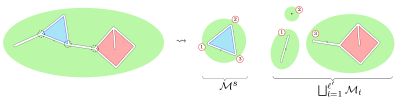
Figure : Elba Garcia-Failde

Orateurs et résumés
Accéder aux résumés au format pdf.
- Thomas Barois (CNRS, Université de Bordeaux)
The guest from another department (physics)
Résumé
This talk of the Journées de combinatoire de Bordeaux will be quite unusual since I won’t talk about combinatoire but about physics. My field of research is not even closely related to combinatoire so I will give a broad-audience overview of my activities. I will talk about different concepts that I find interesting in my research. In no particular order, I will (possibly) talk about robots, paper, oscillators, chirality, traffic, similarity, resonance, … - Lucia Di Vizio (CNRS, Université de Versailles-St Quentin)
Differential transcendence for the Bell numbers and their relatives
Résumé
Martin Klazar proved in 2003 that the ordinary generating function of the Bell numbers is differentially transcendental over the germs of meromorphic functions at 0. We show that this result is an instance of a general phenomenon: on one hand we prove a general result, in a compact way, using difference Galois theory; on the other hand, we obtain as a consequence the differential transcendence of the generating functions of many other combinatorial sequences, including Bernoulli, Euler and Genocchi numbers. These results bring concrete evidence in support to the Pak-Yeliussizov conjecture. Similar results hold for singular walks with small steps in the quarter plane.
This is joint work with A. Bostan and K. Raschel.
- Elba Garcia-Failde (Sorbonne Université)
La relation maîtresse qui simplifie les cartes et libère les cumulants
Résumé
Dans cet exposé, je présenterai des transformations qui apparaissent dans des contextes très différents : des cartes combinatoires qui se simplifient, des constellations qui perdent des couleurs, des cumulants qui se libèrent, et des x et y qui s’échangent symplectiquement dans la récurrence topologique. J’expliquerai comment réaliser toutes ces dualités par le biais d’une transformation universelle qui utilise les nombres de Hurwitz monotones doubles. Exprimer la transformation comme l’action d’un opérateur dans l’espace de Fock nous permet d’utiliser les techniques récentes développées par Bychkov, Dunin-Barkowski, Kazarian et Shadrin pour trouver des relations fonctionnelles reliant les séries génératrices des moments d’ordre supérieur et des cumulants libres, ce qui résout un problème ouvert posé par Collins, Mingo, Sniady et Speicher lors du développement de la théorie de second ordre qui généralise la transformée R de Voiculescu. Cela nous conduit à une théorie générale de la liberté qui prend en compte les corrections de genre supérieur qui apparaissent naturellement dans les autres contextes. Nous introduisons une notion de cumulants libres surfaciques à partir de la combinatoire du poset de permutations surfaciques (une généralisation des permutations partitionnées) qui capture les développements asymptotiques de tout ordre dans les modèles de matrices aléatoires avec invariance unitaire. - Léo Gayral (Université Toulouse III - Paul Sabatier)
A short hike through symbolic dynamics (and the random noise therein)
Résumé
A Subshift of Finite Type (SFT) is a translational-invariant set of colourings of a lattice by a finite alphabet, induced by a finite set of local forbidden patterns. Ergodic theory allows for a bridge between SFTs and a more probabilistic approach, by focusing on “generic” configurations in some sense.
This presentation will focus on what happens when a small amount of random noise, of mismatching patterns, is allowed, in particular as the amount of noise goes to
. I will first introduce some general ideas on symbolic dynamics and ergodic theory, and then move onto the noisy framework to highlight the main results and ideas of the article On the Besicovitch-Stability of Noisy Random Tilings (arXiv:2104.09885). More precisely, after introducing a topology adapted to problem at hand, we will see how we can obtain stability for both periodic and aperiodic tilings. In doing so, we will use mostly elementary probabilistic methods, and in particular study percolations on
with finite-range dependences. - Laure Marêché (Université de Strasbourg)
Classification d’universalité pour la percolation bootstrap et les modèles avec contraintes cinétiques
Résumé
La percolation bootstrap est une classe d’automates cellulaires monotones, dans lesquels chaque site depeut être dans l’état 0 ou 1, un site à l’état 0 reste à 0, et un site à l’état 1 passe à 0 lorsqu’une certaine contrainte est satisfaite, de la forme “il y a assez de sites à 0 dans le voisinage”. Les modèles avec contraintes cinétiques forment une classe de modèles de mécanique statistique que l’on peut voir comme une version probabiliste, non monotone et en temps continu de la percolation bootstrap. En effet, dans ces modèles, un site, quel que soit son état, peut passer à 0 avec probabilité q et à 1 avec probabilité 1-q, mais le changement n’est possible que lorsque la contrainte est satisfaite. Dans les deux classes de modèles, le comportement du système dépend énormément du choix de la contrainte, et il y a une infinité de contraintes possibles. Une question très importante est donc celle de l’universalité : peut-on répartir cette infinité de modèles en un nombre fini de classes de manière que les modèles de chaque classe aient le même comportement ? Pour la percolation bootstrap, Balister, Bollobás, Duminil-Copin, Morris, Przykucki, Smith et Uzzell ont trouvé une telle classification d’universalité. Cela nous a amenés, Hartarsky, Martinelli, Morris, Toninelli et moi-même, à établir une classification d’universalité pour les modèles avec contraintes cinétiques. À cause de leur caractère probabiliste et non monotone, cette classification s’avère plus complexe celle de la percolation bootstrap. Dans cet exposé, on présentera ces deux classifications d’universalité et on expliquera leurs différences. - Jennifer Morse (University of Virginia)
Hey Series, How do you make Macdonald polynomials?
Résumé
We will discuss how the family of symmetric Macdonald polynomials grew out of a study of harmonic polynomials and inspired a long-term program bringing together the combinatorics of Young tableaux and Catalan paths, representation theory, and geometry. We will use a new formula involving Young’s raising operators to describe the Macdonald polynomials and to motivate new open problems in the field.
No prior background on Macdonald polynomials will be required.
Joint work with J. Blasiak, M. Haiman, A. Pun, and G. Seelinger.
- Jonathan Narboni (Université de Bordeaux)
Vizing’s conjecture holds
Résumé
In 1964 Vizing proved that to properly color the edges of a graph, one need at most colors, where is the maximum degree of . In his paper, Vizing actually proves that one can transform any proper edge coloring into a -edge-coloring using only Kempe changes, i.e. only switching the colors of maximal bichromatic components. Soon after his paper, he asked the following question: is an optimal edge-coloring always reachable from any proper edge-coloring using only Kempe changes? Bonamy & al. proved that the conjecture holds for triangle free graphs, following their work, we prove that it holds for all graphs. - Pierre-Guy Plamondon (Université de Versailles Saint-Quentin)
Réalisations de l’associaèdre généralisé par la théorie des représentations
Résumé
L’associaèdre est un polytope introduit par Tamari et par Stasheff au milieu du 20e siècle. La théorie des algèbres amassées de Fomin et Zelevinsky a permis de le réaliser comme polytope normal à un éventail simplicial, puis à généraliser sa définition pour obtenir un polytope pour chaque type Dynkin ABCDEFG.
Dans cet exposé, j’expliquerai comment la théorie des représentations des carquois permet de décrire l’espace des réalisations d’un associaèdre généralisé comme polytope normal à un éventail. Je décrirai quelques applications à la théorie des algèbres amassées.
Ce exposé sera basé sur un travail en commun avec Arnau Padrol, Yann Palu et Vincent Pilaud.
- Pierre Popoli (Université de Lorraine)
Maximum order complexity for some automatic and morphic sequences along polynomial values
Résumé
Automatic sequences are not suitable sequences for cryptographic applications since both their subword complexity and their expansion complexity are small, and their correlation measure of order 2 is large. These sequences are highly predictable despite having a large maximum order complexity. However, recent results show that polynomial subsequences of automatic sequences, such as the Thue-Morse sequence, are better candidates for pseudorandom sequences. A natural generalization of automatic sequences are morphic sequences, given by a fixed point of a prolongable morphism that is not necessarily uniform. In this talk, I will present my results on lowers bounds for the maximum order complexity of the Thue-Morse sequence and the sum of digits function in Zeckendorf base, which are respectively an automatic and a morphic sequence. - Clément Réquilé (Universitat Politècnica de Catalunya)
Énumération des cartes planaires biparties 3-connexes
Résumé
Les cartes planaires biparties sont celles dont les sommets sont proprement 2-coloriables. Elles sont en bijection avec les cartes eulériennes. Tutte a été le premier à les énumerer dans le courant des années 60 en résolvant une équation fonctionnelle satisfaite par leur série génératrice. De là, suivant la décomposition des cartes le long de leurs coins, on peut aussi énumérer les cartes biparties 2-connexes. Cependant, pour les 3-connexes la décomposition analogue ne fonctionne pas directement et le problème semble plus ardu.
Dans cet exposé, nous allons discuter d’une solution qui passe par le modèle d’Ising sur les cartes planaires : on considère l’ensemble des 2-coloriages non-nécessairement propres des sommets d’une carte, et on encode le nombre d’arêtes monochromatiques associées dans la fonction génératrice des cartes 2-coloriées. Le point de départ est un résultat d’algébraicité obtenu par Bernardi et Bousquet-Mélou en 2011 dans le cadre plus général de l’étude du modèle de Potts (q-coloriages).
Travail en collaboration avec Marc Noy et Juanjo Rué.
- Paul Thévenin (Uppsala University)
Components in random meandric systems and the infinite noodle
Résumé
A meandric system of size
is a collection of non-crossing loops which intersect the horizontal axis at the points . The specific study of meandric systems conditioned on being connected has been a topic of interest, as these structures appear in various areas of mathematics, theoretical physics or biology. Here, we study a different question, and investigate the asymptotic behaviour of a meandric system of given size chosen uniformly at random. We prove that converges in some local sense to the so-called infinite noodle, which was introduced by Curien, Kozma, Sidoravicius and Tournier. This allows us in particular to answer a question raised independently by Goulden-Nica-Puder and Kargin, concerning the number of loops in a uniform meandric system: this number grows linearly in , and is concentrated around its mean. Based on a joint work with Valentin Féray (arXiv:2201.11572).
Emploi du temps
Mercredi 8 juin
| horaire | orateur | titre |
|---|---|---|
| 09h30 - 10h30 | Jennifer Morse | Hey Series, How do you make Macdonald polynomials? |
| 10h30 - 11h00 | Pause | |
| 11h00 - 12h00 | Thomas Barois | The guest from another department (physics) |
| 12h00 - 14h00 | Repas à la passerelle | |
| 14h30 - 15h30 | Paul Thévenin | Components in random meandric systems and the infinite noodle |
| 15h30 - 16h00 | Pause | |
| 16h00 - 17h00 | Laure Marêché | Classification d’universalité pour la percolation bootstrap et les modèles avec contraintes cinétiques |
Jeudi 9 juin
| horaire | orateur | titre |
|---|---|---|
| 09h00 - 10h00 | Pierre-Guy Plamondon | Réalisations de l’associaèdre généralisé par la théorie des représentations |
| 10h00 - 10h30 | Pause | |
| 10h30 - 11h30 | Jonathan Narboni | Vizing’s conjecture holds |
| 12h00 - 13h30 | Repas à la passerelle | |
| 14h00 - 15h00 | Lucia Di Vizio | Differential transcendence for the Bell numbers and their relatives |
| 15h00 - 16h00 | Pierre Popoli | Maximum order complexity for some automatic and morphic sequences along polynomial values |
| 16h00 - 16h30 | Pause | |
| 16h30 - 17h30 | Léo Gayral | A short hike through symbolic dynamics (and the random noise therein) |
Vendredi 10 juin
| horaire | orateur | titre |
|---|---|---|
| 09h00 - 10h00 | Elba Garcia-Failde | La relation maîtresse qui simplifie les cartes et libère les cumulants |
| 10h00 - 10h30 | Pause | |
| 10h30 - 11h30 | Clément Réquilé | Énumération des cartes planaires biparties 3-connexes |
Participants
- Jean-Christophe Aval (LaBRI, Université de Bordeaux)
- Axel Bacher (LIPN)
- Cyril Banderier (LIPN)
- Thomas Barois (LOMA)
- Frédérique Bassino (LIPN)
- Alin Bostan (INRIA Saclay)
- Mireille Bousquet-Mélou (LaBRI, Université de Bordeaux)
- Noémie Cartier (LISN)
- Xavier Caruso (IMB)
- Frédéric Chapoton (IRMA)
- Clément Chenevière (IRMA)
- Frédéric Chyzak (Inria)
- Bérénice Delcroix-Oger (IRIF)
- Vincent Delecroix (LaBRI, Université de Bordeaux)
- Lucia Di Vizio (LMV)
- Philippe Duchon (LaBRI, Université de Bordeaux)
- Elba Garcia Failde (IMJ-PRG, Sorbonne U)
- Léo Gayral (IMT, Université Toulouse III)
- France Gheeraert (ULiège)
- Elise Goujard (Imb)
- Olivier Guibert (LaBRI, Université de Bordeaux)
- Vincel Hoang Ngoc Minh (LIPN)
- Bastien LABOUREIX (LORIA)
- Sébastien Labbé (LaBRI, Université de Bordeaux)
- Yvan Le Borgne (LaBRI, Université de Bordeaux)
- Clément Legrand (LaBRI, Bordeaux)
- Théo Lenoir (CMAP (Ecole Polytechnique))
- Jean-François Marckert (LaBRI, Université de Bordeaux)
- Laure Marêché (Institut de Recherche Mathématique Avancée)
- Krishna Menon (Chennai Mathematical Institute (Inde))
- Hugo Mlodecki (LISN)
- Jennifer Morse (University of Virginia)
- Alp Müyesser (Univeristy College London)
- Jonathan Narboni (Labri)
- Erkan Narmanli (LIX)
- Hadrien Notarantonio (Inria Saclay)
- Pierre-Guy Plamondon (Laboratoire de Mathématiques de Versailles)
- Pierre Popoli (IECL)
- Carole Porrier (LIPN)
- Martin Pépin (IRIF)
- Clément Requilé (Universitat Politècnica de Catalunya)
- Zéphyr Salvy (LIGM)
- S Sierra (labri)
- Steffania Sierra (labri)
- Andrea Sportiello (LIPN, Universite Paris 13)
- Adrian TANASA (LABRI)
- Paul Thévenin (Uppsala Universitet)
- Pascal Weil (LaBRI, ReLaX)
- Ivan Yakovlev (LaBRI, Université de Bordeaux)