Les JCB 2016 ont eu lieu du mercredi 27 au vendredi 29 janvier 2016. Les exposés ont eu lieu dans l’amphithéâtre du LaBRI (Bâtiment A30) à l’Université de Bordeaux. La journée du jeudi 28 janvier a pris un format spécial, en l’honneur d’Alexandre Zvonkine.
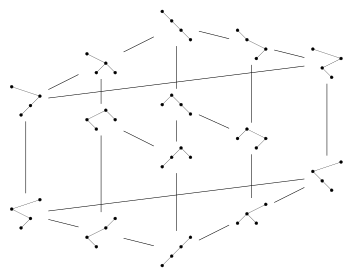
Figure : Gregory Chatel

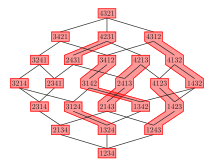
Figure : Grégory Chatel
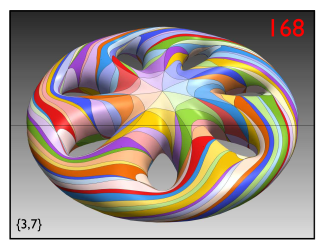
Figure : Jarke van Wijk
Orateurs et résumés
- Luigi Cantini
Asymmetric simple exclusion process with open boundaries and Koornwinder polynomials
Résumé
The Asymmetric Simple Exclusion Process (ASEP) is a stochastic model of particles on the sites of a one-dimensional lattice, that can jump to their right or left neighboring sites under the constraint the neighboring site is empty. Besides being a paradigmatic example of an out of equilibrium system, it has also a rich algebraic and combinatorial structure. In this talk, after a brief review of the general properties of the ASEP, I shall present a new approach to the study of the steady state of this model on a finite strip with two particle reservoirs at the two ends. Our approach consists in exploiting the algebraic structure behind the model in order to introduce a set of “extra” parameters, usually called spectral parameters. The (unnormalized) probabilities of the particle configurations get promoted to Laurent polynomials in the spectral parameters and are constructed in terms of non-symmetric Koornwinder polynomials. In particular we show that the normalization coincides with a symmetric Macdonald-Koornwinder polynomial. As an outcome we compute the steady current and the average density of first class particles. - Michèle Soria
Combinatoire analytique et lois limites gaussiennes
Résumé
La combinatoire analytique étudie le dénombrement asymptotique de structures combinatoires au travers des singularités analytiques de leurs séries génératrices. L’étude de paramètres d’une classe combinatoire est déterminée par une série génératrice bivariée qui est une déformation de la série génératrice de la classe d’origine et l’on peut aussi, souvent, caractériser la distribution limite du paramètre via les déformations subies par les singularités. On étudiera dans cet exposé différents schémas combinatoires-analytiques donnant lieu à des distributions limites gaussiennes obtenues par analyse de singularités, ainsi que leur application à des classes d’arbres, de graphes, de mots, de polynômes… - Jehanne Dousse
Identités de partitions et équations aux q-différences
Résumé
Une partition d’un entier n est une suite décroissante d’entiers positifs (appelés parts) dont la somme est égale à n. Les identités de Rogers-Ramanujan établissent que pour tout n, le nombre de partitions de n telles que la différence entre deux parts consécutives est au moins 2 est égal au nombre de partitions de n en parts congrues à 1 ou 4 modulo 5. Plus généralement, les identités du type Rogers-Ramanujan établissent des égalités entre certains types de partitions avec des conditions de différence et des partitions avec des conditions de congruence. Dans cet exposé, je présenterai plusieurs identités de partitions prouvées durant ma thèse en utilisant des équations aux q-différences. La première est l’identité de Siladic, une identité de partitions prouvée à l’origine avec des techniques d’algèbres de Lie puis reprouvée et raffinée grâce à une étude combinatoire. La deuxième est une généralisation aux surpartitions (des partitions où la première occurrence d’une part peut être surlignée) du théorème de Schur, qui stipule que le nombre de partitions en parts distinctes congrues à 1 ou 2 modulo 3 est égal au nombre de partitions telles qu’il y a une différence d’au moins 3 entre deux parts consécutives et telles que deux multiples de 3 consécutifs ne peuvent être des parts. Enfin, je présenterai une généralisation de deux théorèmes d’Andrews aux surpartitions, ainsi que la nouvelle technique utilisée pour les prouver qui consiste à faire des allers-retours entre équations aux q-différences sur les séries génératrices et équations de récurrence sur leurs coefficients. - Mathias Pétréolle
Extension des formules de caractères en types affines via la décomposition de Littlewood
Résumé
En 2009, Han a redécouvert et généralisé une identité due à Nekrasov et Okounkov, qui fait un lien entre d’un côté, les puissances de la fonction êta de Dedekind, et de l’autre les partages d’entiers et leurs longueurs d’équerres. Pour cela, il utilise la formule de Macdonald pour le système affine de racines de type A. De façon similaire, il existe en type affine C des identités analogues à celle de Nekrasov-Okounkov que je présenterai. Je montrerai comment, en utilisant la décomposition de Littlewood et ses particularités lorsqu’elle est appliquée à certaines partitions (notamment auto-conjuguées), on peut généraliser ces identités avec des paramètres supplémentaires. Enfin, je montrerai les applications de ces généralisations. - Valentin Bonzom
Une généralisation des cartes en dimensions supérieures
Résumé
Les cartes combinatoires sont des discrétisations de surfaces. C’est un enjeu important de les généraliser aux dimensions supérieures. Je présenterai une approche fondée sur l’utilisation de graphes colorés. J’expliquerai comment ceux-ci permettent de géneraliser les p-angulations en représentant des complexes simpliciaux de dimensions. On cherche alors à les classifier selon le nombre de cellules de dimension à nombre de simplexes fixés. Dans cette optique, j’introduirai une bijection avec des cartes colorées dites farcies, qui s’inspire d’une part de la bijection de Tutte entre quadrangulations biparties et cartes quelconques et d’autre part de la représentation de Walsh des hypercartes. Cette bijection permet dans certains cas d’identifier les complexes simpliciaux qui maximisent le nombre de cellules de dimension et d’en calculer les fonctions génératrices. - Grégory Chatel
Algèbre de Hopf cambrienne
Résumé
En 1998, Loday et Ronco décrivent une algèbre de Hopf combinatoire dont la base est indicée par des arbres binaires. Cette algèbre possède de nombreux liens avec divers résultats antérieurs. Son produit est en particulier lié aux intervalles du treillis de Tamari, structure d’ordre partiel dont les éléments sont des arbres binaires. En 2006, Reading définit la notion de treillis Cambrien d’un groupe de Coxeter. Le treillis Cambrien généralise l’ordre de Tamari en utilisant des structures arborescentes qui généralisent les arbres binaires, les arbres Cambriens. Une question naturelle se pose alors : est-il possible de généraliser l’algèbre de Hopf de Loday-Ronco aux arbres Cambriens ? Dans cette présentation, j’expliquerai les résultats que nous avons obtenus avec Vincent Pilaud sur les arbres Cambriens en type A. - Gareth Jones
Revêtements, permutations, et quelques problèmes posés par Sacha Zvonkine
Résumé
Covering of topological spaces can be studied algebraically through their monodromy groups. These are permutations groups, in which the fundamental group of the base space acts by unique path-lifting on the sheets of the covering (more precisely, on the fibre over the base point, or on the cosets of the fundamental group of the covering space). Local branching information provides elements with specific cycle structures. For example, a complex polynomial of degree n, regarded as a covering of the Riemann sphere by itself, yields a permutation group of degree n containing an n-cycle, induced by the branching at infinity. Classical results on permutation groups by Galois, Jordan, Burnside, Schur and Feit can be applied in this and similar situations to classify the possible monodromy groups and hence to understand the coverings. In recent years the work of Sacha Zvonkine on polynomials, Laurent polynomials and related functions has motivated further extensions of some of these results. - Sergei Lando
Combinatorial solutions to integrable hierarchies
Résumé
The talk will present a review of modern approaches to constructing formal solutions to integrable hierarchies of mathematical physics, whose coefficients are answers to various enumerative problems. The relationship between these approaches and combinatorics of symmetric groups and their representations will be explained. Applications of the results to constructing efficient computations in enumeration of various kinds of maps will be given. - Laurent Bartholdi
Revêtements ramifiés de la sphère: informatique et algèbre
Résumé
Les revêtements ramifiés de la sphèresont des objets fondamentalement topologiques. Je tâcherai de montrer comment ils correspondent à des objets algébriques (des “H-G-ensembles” : ensembles avec deux actions de groupes qui commutent) et à des objets analytiques (des fonctions rationnelles). Les auto-revêtements ramifiés dont l’orbite des points critiques est finie ont été profondément étudiés en dynamique holomorphe ; on les appelle des “applications de Thurston”. Je montrerai, au moyen des outils mentionnés plus haut, que le problème de conjugaison de telles applications est décidable. Il s’agit d’un travail en commun avec D. Dudko. - Jarke van Wijk
Visualization of regular maps
Résumé
Regular maps can be viewed as generalizations of Platonic solids: a regular map is a tesselation of a surface (with genus) that is face-, edge-, and vertex-transitive. Up to genus 100 all possible regular maps have been enumerated, and these can be completely and compactly described via their group representations. But, what do they look like? In computer graphics terminology, only the structure of the polygonal mesh is given, but no information about possible geometric realizations is provided. Can we produce visualizations of such regular maps on surfaces embedded in 3D? Finding such visualisations by hand in a challenging puzzle, and almost impossible for the more complex cases. In my talk I will present methods that can be used to produce visualizations automatically. Currently, by far not all cases can be dealt with, but the resulting set includes a variety of interesting cases, such as a visualization of the Macbeath surface. - Dimitri Zvonkine
Hurwitz numbers for real polynomials
Résumé
There are(properly normalized) complex degree polynomials with fixed critical values. This can be found by establishing a one-to-one correspondence between these polynomials and marked trees, which are enumerated by the Cayley formula. The number of (properly normalized) real degree polynomials with fixed real critical values is equal to the -th Euler-Bernoulli number. This can be found by establishing a one-to-one correspondence between these polynomials and alternating permutations. The problem above can be generalized by allowing multiple critical values and fixing their ramification profiles. In the complex case this problem is solved; in the real case, however, the answer depends on the order of the critical values on the real line. Thus the question arises whether it is possible to attribute a sign to every real polynomial in such a way that the number of polynomials counted with signs is invariant under permutations of critical values. We construct a sign with this property and study the invariant thus obtained. This is a joint work with Ilia Itenberg. - Alexandre Zvonkine
Weighted trees
Résumé
Half a century ago, in 1965, Birch, Chowla, Hall, and Schinzel posed the following question. Letand be two coprime polynomials. What is the minimum possible degree of the difference ? In 1995, Zannier considered a more general problem: what is the minimum degree of the difference of two polynomials with a prescribed factorization pattern? Subsequent studies revealed two phenomena. First, when the minimum degree is attained, the polynomials in question turn out to be defined over number fields; therefore, the universal Galois group (the automorphism group of the field of algebraic numbers) acts on these polynomials. Second, the theory of dessins d’enfants makes it clear that the problem is closely related to the study of “weighted trees”. These are plane trees whose edges are endowed with positive integral weights. In particular, the Galois group acts also on such trees, and many aspects of this action, both on trees and on polynomials, can be explained by combinatorial properties of the trees. This is a joint work with Fedor Pakovich and Nikolay Adrianov. - Stephen Melczer
Connectiong analytic and asymptotic behaviour through multivariate diagonals
Résumé
Recent work in the study of analytic combinatorics in several variables has shown how to derive asymptotics for the coefficients of certain families of D-finite functions by representing them as diagonals of multivariate rational functions. In this talk we look at applications of this theory to the enumeration of two dimensional lattice paths in restricted regions: the classical “kernel method” allows one to represent the generating functions of many combinatorial classes arising in this context as diagonals, whose analytic behaviour can then be studied. In particular, we examine a close link between combinatorial properties of the lattice path models (such as their “drift”), the singularities of the associated multivariate rational functions, and the asymptotics of their counting sequences. This allows us to prove conjectured asymptotics of Bostan and Kauers (2009) for walks in two dimensions restricted to the positive quadrant, and newer conjectures of Bostan, Chyzak, van Hoeij, Kauers, and Pech (2015) on the number of walks returning to each bounding axis and the origin. This is joint work with Mark Wilson, George Labahn, Bruno Salvy, and Marni Mishna. - Feri Kardos
Cycles hamiltoniens dans les graphes planaires
Résumé
Tait conjectured in 1884 that each cubic planar graph contains a Hamilton cycle. Had the conjecture been true, it would have implied the Four Color Theorem. However, it was disproved by Tutte in 1946. Later on, other counterexamples with different structural properties were found. On the other hand, for several subclasses of cubic planar graphs hamiltonicity was proven. In general, the problem of founding a Hamilton cycle in a cubic planar graph turned out to be NP-complete. All known conterexamples to Tait’s conjecture contain (i) odd cycles and (ii) faces of large size. That’s why Barnette formulated in the 60s two conjectures in the form of sufficient conditions for the hamiltonicity of cubic planar graphs: he conjectured that bipartite cubic planar graphs, as well as cubic planar graphs with faces of size at most 6, are hamiltonian. We will present results, methods and ideas leading to a computer-assisted proof of the latter. - Dan Betea
Asymptotics of pyramid partitions and related domino tilings
Résumé
We consider the large scaling limit of a class of domino tilings known as pyramid partitions using the technique of Schur processes developed in the mathematical physics community. We give a flavour of the various limiting processes involved, and if time permits look at generalizations and related models such as plane overpartitions, skew pyramid partitions, and the Aztec diamond.
Emploi du temps
Mercredi 27 janvier
| horaire | orateur | titre |
|---|---|---|
| 08h45-09h00 | Accueil et café | |
| 09h00-09h45 | Luigi Cantini | Asymmetric simple exclusion process with open boundaries and Koornwinder polynomials |
| 09h45-10h30 | Michèle Soria | Combinatoire analytique et lois limites gaussiennes |
| 10h30-11h15 | Pause café | |
| 11h15-12h00 | Jehanne Dousse | Identités de partitions et équations aux q-différences |
| 12h00-14h00 | Déjeuner | |
| 14h00-14h45 | Mathias Pétréolle | Extension des formules de caractères en types affines via la décomposition de Littlewood |
| 14h45-15h30 | Valentin Bonzom | Une généralisation des cartes en dimensions supérieures |
| 15h30-16h15 | Pause café | |
| 16h15-17h00 | Grégory Chatel | Algèbre de Hopf cambrienne |
Jeudi 28 janvier
| horaire | orateur | titre |
|---|---|---|
| 09h00-10h00 | Gareth Jones | Revêtements, permutations, et quelques problèmes posés par Sacha Zvonkine |
| 10h00-11h00 | Sergei Lando | Combinatorial solutions to integrable hierarchies |
| 11h00-11h30 | Pause café | |
| 11h30-12h30 | Laurent Bartholdi | Revêtements ramifiés de la sphère: informatique et algèbre |
| 12h30-14h15 | Déjeuner | |
| 14h15-15h15 | Jarke van Wijk | Visualization of regular maps |
| 15h15-16h15 | Dimitri Zvonkine | Hurwitz numbers for real polynomials |
| 16h15-16h45 | Pause café | |
| 16h45-17h45 | Alexandre Zvonkine | Weighted trees |
| 18h | Vins et fromages au LaBRI |
Vendredi 29 janvier
| horaire | orateur | titre |
|---|---|---|
| 09h00-09h45 | Stephen Melczer | Connectiong analytic and asymptotic behaviour through multivariate diagonals |
| 09h45-10h30 | Feri Kardos | Cycles hamiltoniens dans les graphes planaires |
| 10h30-11h15 | Pause café | |
| 11h15-12h00 | Dan Betea | Asymptotics of pyramid partitions and related domino tilings |
Participants
- Dan Betea (ENS Paris)
- Valentin Bonzom (LIPN)
- Luigi Cantini (Université de Cergy-Pontoise)
- Grégory Chatel (LIGM, Université Paris-Est)
- Jehanne Dousse (Liafa, Université Paris Diderot)
- Fery Kardos (LaBRI, Université de Bordeaux)
- Steven Melzcer (University Waterloo / ENS Lyon)
- Mathias Pétréolle (ICJ Université Claude Bernard (Lyon))
- Michèle Soria (LIP6, Université Paris 6)
- Laurent Bartholdi (Georg-August Göttingen / ENS Paris)
- Gareth Jones (University of Southampton)
- Sergei Lando (HSE Moscou)
- Jarke van Wijk (Eindhoven University of Technology)
- Alexandre Zvonkine (LaBRI, Université de Bordeaux)
- Dimitri Zvonkine (Université Paris 6)
- Yvan Le Borgne (LaBRI, CNRS)
- Mireille Bousquet-Mélou (CNRS, LaBRI, Bordeaux)
- Thibault Manneville (LIX - UMR 7161, Polytechnique)
- Marie Albenque (LIX, CNRS)
- Matthieu Josuat-Vergès (Laboratoire d’Informatique Gaspard Monge, CNRS)
- Jérémie Bouttier (IPhT, CEA Saclay)
- Pascal Weil (LaBRI, CNRS)
- Adrian Tanasa (Labri, univ. Bordeaux)
- Marthe Bonamy (LaBRI, CNRS)
- Clément Dervieux (LIAFA)
- Philippe Nadeau (CNRS & ICJ, Univ. Lyon 1)
- Joël Gay (LRI)
- nicolas magot (CHU Bordeaux)
- Jean-François Marckert (LaBRI, CNRS)
- Alin Bostan (INRIA)
- Jean Bétréma (LaBRI*)
- Robert Cori (LaBRI)
- Bérénice Delcroix-Oger (IMT)
- Philippe Marchal (CNRS et Paris 13)
- Wenjie Fang (LaBRI)
- Jean-Christophe Aval (LaBRI, CNRS)
- Nicolas Bonichon (LaBRI, Université de Bordeaux)
- Gwendal Collet (TU Wien)
- Cyril Banderier (LIPN, Univ. Paris Nord / CNRS)
- Henri Derycke (Labri)
- Paul Dorbec (LaBRI, Univ. Bordeaux)
- Philippe Duchon (LaBRI, Université de Bordeaux)
- Marc Zeitoun (LaBRI)
- Sylvain Carrozza (LaBRI)
- Linxiao Chen (Département de Mathématiques, Université Paris-Sud)
- Olivier Guibert (LaBRI)
- Jenny Benois-Pineau (LABRI)
- bruno courcelle (labri)
- Géraud SÉNIZERGUES (LaBRI)
- Romaric Duvignau (LaBRI)
- Patxi Laborde-Zubieta (LaBRI)
- Niccolo CASTRONUOVO (LaBRI et Université de Bologne)
- Jean-Christophe Novelli (LIGM)
- François Viard (ICJ)
- François Nunzi (LIAFA)
- Minmin Wang (Labri)
- Olivier Delmas (LaBRI)
- André Raspaud (LaBRI)
- Jean-Rémy FALLERI (LaBRI)
- Mike Robson (LaBRI)
- Frédérique Carrere (LABRI)
- Gilles Zémor (IMB)
- Alain Lasjaunias (IMB)
- Pierrette Cassou-Nogues (IMB)
- Ralf Klasing (LaBRI, CNRS)
- Alain Griffault (LaBRI)
- Adrien Boussicault (LaBRI)
- Serge Chaumette (LaBRI)
- Imad Eddine Bousbaa (laboratoire RECITS, USTHB)
- Zakaria Chemli (LIGM, Université Paris-Est)
- Andrea Sportiello (LIPN, Université Paris 13)
- Mohamed Mosbah (LaBRI)
- Théo Pierron (LaBRI)
- Omar TOUT (LaBRI)
- Yuri Bilu (IMB)